
(April 24, 2013) Another article exploring the brewing debate over the cause or causes of the April 20 Lushan earthquake reports that the quake may have been an aftershock of Sichuan’s 2008 earthquake disaster, which some experts believe was triggered by the Zipingpu Dam reservoir. This issue of “reservoir-induced seismicity” is fast gaining attention as China, the most dammed nation in the world, is particularly at risk to the phenomenon. A 2011 Chinese study, for example, found China’s massive Three Gorges Dam had triggered around 3,000 earthquakes and numerous landslides in the reservoir region, representing a 30-fold increase in seismic activity in the area.
Sichuan quake highlights dam risk
(April 24, 2013) In regions noted for geological instability, engineering projects built along fault lines are not only vulnerable, but may, in part, be to blame for earthquakes.
Shifting tectonic plates, aftershock, dam-related, or all three?
(April 22, 2013) Experts are debating whether the 7.0-magnitude earthquake that struck Sichuan province over the weekend was an aftershock of the region’s deadly 2008 Wenchuan earthquake – both quakes occurred along the same fault line. Some attribute Saturday’s event to natural movement in the earth’s crust but according to Fan Xiao, chief engineer at the Sichuan Bureau of Geology and Mineral Resources, the Wenchuan quake is also linked to the nearby Zipingpu Dam reservoir. Speaking to the Global Times, Mr. Fan said large reservoirs built on fault lines can induce earthquakes caused by the pressure of massive water volume on a fracture. “A reservoir with a capacity of over 1 billion cubic meters and a dam more than 100 meters tall would have a 30 percent to 40 percent chance of inducing an earthquake,” he said.
Sichuan earthquake may be aftershock of 2008 killer quake: Chinese geologist
(April 22, 2013) China’s construction of huge dams increases the probability of earthquakes, Fan Xiao warns.
Deadly earthquake in China may be aftershock of 2008 Wenchuan quake
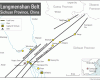
(April 21, 2013) The strong earthquake that struck China’s mountainous Sichuan province Saturday morning may have been an aftershock, says prominent Chinese geologist, Fan Xiao. The accumulation of stress had not yet been fully released, making this region a more dangerous area after the May 2008 Wenchuan earthquake.
On alert: RIS risk amid rash of earthquakes in China’s Sichuan-Yunnan region
(March 22, 2013) A new report, exclusive to Probe International, calls for urgent monitoring of China’s large dams in areas prone to seismic hazard. These areas may be at increased risk from dam reservoir-induced seismicity (RIS). Scientists have observed that reservoir impoundment may not only increase the risk of strong earthquakes, particularly in areas already vulnerable to high-intensity seismic activity, but may represent a more pronounced risk in the first few years after a dam is filled.
Cyberwar and secrecy threaten China’s dams
(March 12, 2013) China may be the world’s biggest cyberspace aggressor, but security specialists say China’s computer-controlled infrastructure is more vulnerable to cyber-attacks and to malfunctioning domestic software than are Western systems. Read Patricia Adams’ piece in the Huffington Post on why China’s dams are vulnerable to both.
Member of the National Committee of CPPCC urges hydro development on the Nu River
(March 4, 2013) In a throwback to Maoist propaganda, a member of China’s National Committee of the Chinese People’s Political Consultative Conference has promised that building a rash of dams on China’s Nu River will cure all ills, and bring harmonious development, and leap-forward development to boot. In reality, scientists worry that the dams will trigger earthquakes and landslides and be unable to operate at full capacity for lack of water. Downstream countries are also worried about the loss of natural river flow on which their economies depend.
Too dam much
(February 14, 2013) A dramatic push by China’s new leadership to revive a political passion for large dam projects has ignited concerns for neighbouring countries and environmentalists.
China moves to dam the Nu, ignoring seismic, ecological, and social risks
(January 25, 2013) Environmental NGO International Rivers reports on Beijing’s move to lift a moratorium on damming China’s Nu River despite “well-documented seismic hazards, ecological and social risks”.
Nu River faces fresh threat
(January 25, 2013) A revival of plans by Beijing to embrace mega dams and the mega risks associated with them has left Chinese environmentalists reeling.
Trouble on the Yangtze

(December 19, 2012) A central government plan to dramatically increase China’s reliance on non-fossil fuels will derive two-thirds of that target from hydropower – “an increase on par with adding nearly one Three Gorges Dam a year,” reports Jane Qiu for Science magazine. In her article on over-development of the country’s river pulse, the once mighty Yangtze, Qiu looks at the threat China’s damming fever poses to river habitats and species, the calamity potential of dam construction in quake-prone regions and mounting criticism of China’s biased environmental impact assessment process.
Press Release: 80,000 deaths from 2008 Chinese earthquake was likely not an act of God, says new study
(December 12, 2012) A new study published by Probe International reveals a dangerous relationship between dam reservoirs and seismic activity.
Aftershock from 2008 Wenchuan quake hits Sichuan
(December 4, 2012) Experts say the tremor that jolted Sichuan Province last weekend is an aftershock of the killer quake that struck the province in 2008, linked to the Zipingpu Dam.
China surveys Yangtze dolphin as extinction looms

(November 30, 2012) Chinese scientists have begun an expedition to count how many endangered finless porpoise remain in the Yangtze River. A similar survey in 2006 found only 1,800 of the animals, considered a national treasure, as well as a symbol of the mighty river itself and a reflection of the great waterway’s health.



 Probe International