
Two days before the country’s new environmental law took effect, six polluting companies in east China’s Jiangsu Province were walloped with the most costly penalties ever imposed by a Chinese court. Is […]
Harsher laws will not curb incentives to pollute

Chinese environmentalists explain why the incentives that work in favour of pollution, rather than its prevention, will remain, despite new legal powers. Radio Free Asia reports.
China’s water revival
Chinese citizens and industry are both willing to do their part to help turnaround the country’s water crisis, according to a new survey, but they don’t see how without a mechanism that allows the government, industry and end users to work together. Could that missing mechanism be market discipline, rule of law and citizen empowerment?
The heat is on for the ‘living fossil’

Despite its long lineage as one of the world’s oldest living species, the Chinese sturgeon — known as the “living fossil” because it dates back to the Cretaceous period — may not survive the surging dams and bridges built over the Yangtze River, reports China Daily.
Big deal U.S.-China climate change pact buried in Beijing
Why did Beijing downplay a “historic” climate change pact with the U.S.? Is it China’s famed reserve? Or is it to keep a lid on citizens’ post-summit APEC blues?
Unable to clean air completely for APEC, China resorts to blocking data
China’s various restrictions and outright bans to ensure clearer skies over Beijing for APEC succeeded to such an extent a new phrase entered the country’s Internet lexicon — “APEC blue”. Meanwhile, smog the government’s strict clean-up measures couldn’t prevent was contained by a data shutdown that blocked the city’s pollution readings.
Concern mounts in China over Yangtze diversion project
China’s ambitious South-to-North Water Diversion project officially begins flowing next month and the impacts of the costly geo-engineering giant are starting to be felt in the regions tapped to redistribute water to the country’s parched north. “This project from the beginning has been as controversial as the Three Gorges,” says Probe International fellow and leading Chinese environmental journalist, Dai Qing.
Saving China’s environment
Read in full Patricia Adams’ closing address to the International Symposium on China’s Environmental Crisis: Is There a Way Out? A resounding “Yes!” says Ms. Adams. “Give power to the people”.
China’s environmental crisis: Is there a way out?
China’s environmental crisis is the subject of an upcoming international symposium later this month, presented by the Riley Institute at Furman University and the Furman Department of Asian Studies. Probe International’s Patricia Adams will give the closing address on “Saving China’s Environment: Give Power to the People”.
China’s Lacang River dams – impacts already ‘extensive’

Already, newly completed cascade dams along China’s Lancang River are altering the river’s hydrological regime and sediment flow, blocking fish migration and posing a risk to food security and livelihoods. As more cascade dams roll out along the Lancang, International Rivers offers a better understanding through their research of the environmental impacts of current development and what further impacts can be expected as more projects come online.
The biggest victim of the Three Gorges Dam: Shanghai?
Shanghai will suffer Three Gorges Dam impacts the most, says report.
China flattening mountains to build more ghost cities?

A mind-boggling new twist on the road to urbanization.
China’s new environmental law looks good … on paper

(April 24, 2014) Chinadialogue’s Beijing editor Liu Jianqiang reviews China’s newly revised environmental protection law which comes into effect in 2015 and represents the first time the law has been revised in 25 years. The new law provides authorities with the tools to dole out harsher punishments and sanctions to polluters, including more heat for officials found to be falsifying data and ducking environmental impact assessments. Under the new law, individual citizens still will not be able to initiate public interest lawsuits and although NGOs will be able to pursue litigation, the number permitted to do so has been capped, most likely in order to prevent a flood of environmental lawsuits in local courts and local authorities from being sued too frequently — which raises the question: what is the point of the law? In any case, says Mr. Liu, China’s environmental problems cannot be blamed solely on the lack of a powerful law but are more “the consequence of weak implementation and failure to hold officials accountable for rampant pollution and ecological destruction. … What good is perfect legislation if our authorities fail to implement it? China’s new law cannot answer this question.”
China’s desperate need for water is forcing the relocation of hundreds of thousands of people
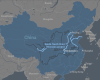
(March 17, 2014) Part two of Lily Kuo’s substantial overview of China’s South-to-North Water Diversion project (SNWDP) and its resettlement process. Kuo notes that since 1949, more than 45 million Chinese have been displaced by infrastructure projects and, of those, 12 million have been moved for water schemes. The water projects, she notes, have a particularly depressing record in terms of outcomes for the resettled. Although there are signs, she says, of villagers moved for the SNWDP receiving better care than those in the past, the same old resettlement problems abound. Worst of all, there are no farms to tend and jobs to do. “This isn’t a life,” says one migrant of the soul-destroying joblessness. “In the morning, you see everyone sleeps in. In the afternoon, they play cards. That’s it.”
Distorted economy dooms China to an “airpocalypse”
(March 4, 2014) With China’s economy operating under perverse incentives, China’s leaders, now assembled in Beijing, will be powerless to clean up its environment.



 Probe International