
To most observers, Chinese officialdom has supported the Three Gorges Dam without fail. But a closer look reveals growing worries about the dam which has become a symbol of all that is wrong with China’s rise. Here we present Chinese officials’ admissions of problems at Three Gorges, from the sensational mea culpas of senior officials to the subtly expressed worries of eminent scientists.
Shale gas in China
(September 28, 2011) Shale gas is a burgeoning (if controversial) industry in the United States, but in China, which may have reserves to rival the U.S., development is only beginning. Liu Zhi, of Beijing’s Transition Institute, discusses the potential and the problems of China’s shale gas industry.
Dams gone wrong: Is danger lurking in China’s dams?
(August 24, 2011) One of China’s premier investigative news agencies reveals China’s dams “are like ticking time bombs:” beset by disaster, flaws, poor construction, neglect, and fraud.
Misery along the Yangtze provokes frank discussions about the “monstrous” Three Gorges dam
(June 12, 2011) A consensus is building that the Three Gorges dam, which the Shanghai Daily calls “that” monstrous damming project,” dried downstream lakes. Predictions to this end made by renowned hydraulic engineer Huang Wanli, nearly 20 years ago, prove to be eerily accurate.
Amid severe drought, Chinese government admits mistakes with Three Gorges Dam
(June 4, 2011) The Washington Post features Probe International Fellow Dai Qing and cites Probe International’s expose of a 30-fold increase in earthquakes caused by China’s Three Gorges Dam.
Return of the dambusters
The latest controversy over the Three Gorges Dam puts the lie to the notion that the advantages of a one-party autocracy trump political gridlock.
Three Gorges aggravates downstream water shortage
(May 25, 2011) Contradicting official claims that the Three Gorges reservoir plays no part in exacerbating the drought in the Yangtze River basin, Ma Jun of the Beijing-based Institute of Public and Environmental Affairs, a non-government organization, told Reuters: “Without the Three Gorges Dam, the water level in the Yangtze would not be that low.” Faced with the downstream drought crisis, Three Gorges officials have been ordered to release water, thus hampering their ability to generate power. Added Ma: “Fundamentally there is a conflict between hydropower generation and water supply, irrigation, and navigation.”
China’s mea culpa: Three Gorges Dam problems must be “solved urgently”
(May 19, 2011) Amid power shortages and potential catastrophe, China admits to failings in the Three Gorges Dam. Probe International Fellow Dai Qing responds from Beijing.
The Three Gorges Dam’s new normal: failure
(May 18, 2011) China’s drought has caused the Three Gorges reservoir level to drop precipitously, crippling the mighty Three Gorges Dam. Shipping on the Yangtze River has now halted, power generation has been compromised, and geological hazards are heightened.
China regions face power shortage even before summer peak
(April 18, 2011) Reuters is reporting that China will face power shortages due to coal shortages, and low water levels in hydrodams.
Zeng Jinyan: Salt panic highlights a crisis of confidence in China

(April 12, 2011) In this first in a series, Voices From China, Chinese blogger Zeng Jinyan writes that the panicked response of Chinese citizens to the Japanese nuclear crisis betrays a fundamental distrust of the Chinese Government and official media.
Dai Qing: On The Completion of the Three Gorges Project
(April 7, 2011) Dai Qing, Chinese investigative journalist and Probe International Fellow, delivered the following speech about the Three Gorges Dam project in November 2010 while on a speaking tour in British Columbia, Canada. In her address, she reports that the problems predicted by dam critics published in her books, “Yangtze! Yangtze!” and “The River Dragon Has Come!,” are now coming true.
China Three Gorges Hydropower Project Proceeds as Planned After Protests
(April 1, 2011) It is business as usual for the China Three Gorges Corporation, operator of the world’s largest dam and builder of the Xiangjiaba hydropower project in southwestern China, after 2,000 protesters were dispersed by 1,500 riot police.
Dams damaged in Yushu earthquake
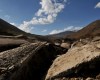
(May 22, 2010) The April 13, 2010 Yushu earthquake damaged three dams on the Batang River, putting one at risk of collapse.
State policies leaving Chinese citizens out in the cold
(January 11, 2010) While citizens across China are confronting some of the most severe winter weather in decades, they’re finding that holdover policies from the Maoist era are making the situation worse.



 Probe International