
Legendary Chinese investigative reporter Dai Qing on the events of 1989 and her Chiang Mai years.
Reporter: Qianlang | Editor-in-charge: Chen Meihua, Xu Shuting, Jiayuan | Web Editor: Ruizhe
Published by Radio Free Asia on September 9, 2024
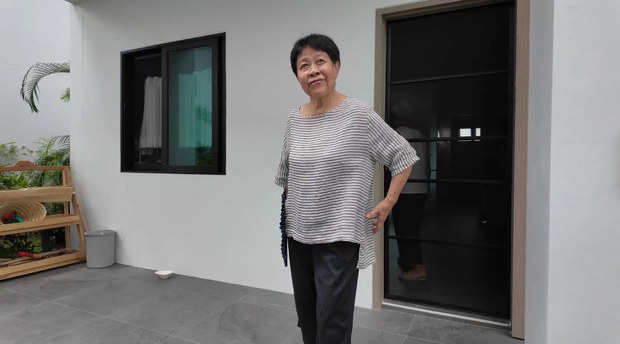
Dai Qing, a well-known Chinese journalist, who has been out of the public eye for more than two decades, recently gave an exclusive interview to Radio Free Asia in Chiang Mai, Thailand, where she recalled her arrest during China’s 1989 student movement and the process of talking to the Communist party’s top leaders on behalf of students.
The interview is is spread across two reports. This is the first installment.
Dai Qing and her recently retired daughter live in a lush green “villa shanty” more than ten kilometers away from the ancient city of Chiang Mai, Thailand. One day in late July, a reporter went there accompanied by writer Wang Ji. Dai Qing warmly welcomed them. She spoke humorously in a loud voice. No one believed that she was over 80 years old.
At the eastern end of the 31-household courtyard, which is known as the “writers’ village” and “a small gathering place for intellectuals,” is a study room shared by neighbors. It is quiet, bright, and filled with the fragrance of books. Wang Ji, who lives in the same community as Dai Qing, said that the rows of books on the bookshelf were donated by Dai Qing when the community named “Juyuan” was first built two years ago. When the group sat down, Dai Qing pulled out a copy of “Memoirs of Yan Mingfu” and said, “Yan Mingfu is gone. We had several encounters during the Tiananmen student movement in 1989. Last year, when he just passed away, so many people wrote articles in remembrance of him! I hesitated. It was a detail of my experience, a very important detail. After thinking about it, I still didn’t write it down.”

Dai Qing: Yan Mingfu said, “If students continue to cause trouble, Zhao Ziyang will be finished.”
During the 1989 student movement, Yan Mingfu, then Minister of the United Front Work Department of the CPC Central Committee, was ordered to communicate and coordinate with college students in Beijing. Dai Qing, representing the public and students, conveyed the attitude of the CPC’s top leaders. She says:
“When Yan Mingfu passed away, there was one most crucial thing that I did not write down. I represented the civilian side, and he represented the official side. Then when the two of us were negotiating conditions, we discussed what conditions would allow the students to withdraw. I said, we should say, ‘Classmates, you have done a great job, democracy, this and that.’ Yan Mingfu said it was impossible, and he said I could ask Zhao Ziyang or Li Peng to visit them. I said, then say a few words after you visit them, (Yan Mingfu said) No, in the end I could only say ‘Hello classmates,’ and I couldn’t say a single word more.”
Dai Qing continued, “I turned around and said, ‘Then I will convey your message (to the students).’ As soon as I turned around, he stopped me from behind and said, ‘Tell them to make trouble. If they continue to make trouble, Zhao Ziyang will be finished!’ Then, when I was in prison, the police asked me, ‘You met Yan Mingfu, what did he say?’ This sentence is not in my record.”
Dai Qing is a famous Chinese journalist, writer and social activist who worked as a reporter for Guangming Daily. She is known for her investigative reporting and attention to environmental issues, especially in the late 1980s when she opposed the Three Gorges Dam project. The Tiananmen Square incident in 1989 was a major turning point in Dai Qing’s life. She was arrested and detained for six months after the incident. After her release, she was strictly controlled by the authorities and was not allowed to accept interviews or make public statements, but she continued to promote issues such as democracy, human rights and environmental protection through her writing. Dai Qing has now left China and has temporarily taken up residence in Chiang Mai, Thailand with her daughter.
The following is a conversation with Dai Qing about her choice to move to Thailand and her lifestyle here:
Reporter: “Why did you choose Chiang Mai instead of other places?”
Dai Qing: “It should be said that choosing Chiang Mai was not my choice. I have always lived in big cities since I was a child. When they asked me where I was from, I said I was Chinese. For example, I was born in the wartime capital Chongqing, and later I worked in middle school in Beijing. I have always been in big cities. I really don’t like big cities, I don’t like the luxury and noise, I like quietness, trees and grass, blue sky and white clouds.”
Dai Qing is one of the 31 households in the “Writers Village”.
There are swimming pools, trees and flowers in the “Writers’ Village”. Dai Qing feels relaxed and happy living with her daughter.

Dai Qing: “At that time, our Juyuan was called ‘a small community of friends’. We all had the same values and common hobbies, such as reading. We set up a research center and invited all foreign universities to come here if you are interested in China. We have so many people here who can chat with you, share our experiences, and you can live here.
Today, there are 31 houses. They were designed by Ye Fu (writer). Many of them are his friends, and they just come. This amount of money is less than one-fifth of the houses in Beijing, right? They come, but they don’t live here. Some are rented out. Who do they rent to? That’s another question. People who are dissatisfied with the Chinese education system want to bring their children here to study and enroll in the British education system. We rent houses to them. There are several families like them. You can see that the most chaotic and lively ones are full of children.”
Reporter: “Did they come before the epidemic or after the epidemic?”
Dai Qing: “Some came earlier and some came later, so there are basically two groups of people here. The first group is people who are dissatisfied with China’s education system and come here to take their children to school. The second group is Ye Fu, Tang Yun, and Wang Ji. People like us are those who have suffered political discrimination and oppression in China and cannot go back, so we also come here.”
Dai Qing recalls China before Hu Yaobang’s death
Reporter: “So you are classified as someone who came here because she was dissatisfied with Chinese politics. Can I understand it that way?”
Dai Qing: “It’s not that simple. It’s just like this. I have an article that I’ll send to you in 1989. I don’t remember who asked me to write about 1989, or my own experiences. In the three months before Hu Yaobang’s death in 1989, China’s civil society was not able to achieve a modern transformation, but it was actually much more relaxed. We could do a lot of things. Then Hu Yaobang died 58 days later. Then the suppression continued, and it has become what it is today.”
Regarding the history of 1989, Dai Qing, who used to be engaged in investigative reporting, said: “I was originally, because after all, I was a journalist, after all, I had contact with people from all walks of life, I knew you, my name is Chai Ling, you are Chairman Mao’s good student, you think you can gather heroes by raising your arms, you are the leader below? Don’t think so, it’s not like that. I kept telling them, you keep resisting, saying you have to make concessions, we students want democracy, it’s not right, (the top leaders) have already made concessions, let’s go back, I was trying to persuade them to make peace, and they even put me in Qincheng.”
Dai Qing summarizes current life with “three no’s and two no’s”
When talking about the current situation, Dai Qing summarized it as “three no’s and two no’s”: “I now summarize myself as ‘three no’s and two no’s. The three no’s are: no pension, no social security, no medical insurance; the two no’s are: first, I don’t get sick, and second, I don’t hire workers. I do everything myself.”

Dai Qing completes 35th anniversary edition of new work “Deng Xiaoping in 1989”
Dai Qing, who is usually very low-key, has been writing non-stop and has completed the 35th anniversary edition of Deng Xiaoping in 1989. Her new work, Notes on History, will be published in the United States soon.
In the small swimming pool of Juyuan, 83-year-old Dai Qing showed us her skills as a member of the military swimming team more than 60 years ago: after three consecutive strokes of breaststroke, backstroke and freestyle, she said: “Sorry, I can’t jump up the “dolphin style”!”
Read the original version of this article at the publisher’s website here.
 Patricia Adams
 Dai Qing
 Fan Xiao
 Lawrence Solomon
 Mu Lan
 Probe International
 Lisa Peryman
 Patricia Adams and Lawrence Solomon
 Other News Sources


