
Many of the more than 300,000 Chinese moved to make way for the country’s monumental South-North Water Diversion project have been left unemployed in leaking, shoddy houses, while few say they have […]

Many of the more than 300,000 Chinese moved to make way for the country’s monumental South-North Water Diversion project have been left unemployed in leaking, shoddy houses, while few say they have […]
China will soon turn on the taps of the world’s biggest water-diversion project.
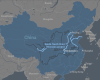
(March 17, 2014) Part two of Lily Kuo’s substantial overview of China’s South-to-North Water Diversion project (SNWDP) and its resettlement process. Kuo notes that since 1949, more than 45 million Chinese have been displaced by infrastructure projects and, of those, 12 million have been moved for water schemes. The water projects, she notes, have a particularly depressing record in terms of outcomes for the resettled. Although there are signs, she says, of villagers moved for the SNWDP receiving better care than those in the past, the same old resettlement problems abound. Worst of all, there are no farms to tend and jobs to do. “This isn’t a life,” says one migrant of the soul-destroying joblessness. “In the morning, you see everyone sleeps in. In the afternoon, they play cards. That’s it.”
(October 28, 2013) This excellent report by Agence France-Presse looks at the growing number of drawbacks posed by China’s South-to-North Water Diversion project and asks whether the $80-billion geo-engineering giant is creating more problems than it is supposed to solve. For example, the strong risk of collecting and distributing tainted water from the supply waterways it draws from, which would render the water carried unusable; the energy required to move water uphill for long sections; the displacement of entire communities in large numbers for reservoir construction, as well as the construction feats required to pull off certain aspects of the project’s plans – such as blasting channels through mountains in earthquake zones on the Tibetan plateau. Not to mention the threat posed by construction of this scale in seismically active zones.

(January 22, 2013) China’s largest-ever forced relocation effort, in the northwestern gateway province of Shaanxi, is set to transform the lives of more than 2.8 million people over a period of 10 years. The massive migration, even by China’s standards, is currently underway in part to make way for another of the country’s vast infrastructure projects, the enormous south-north water transfer scheme; in part due to environmental degradation – geological instability caused by deforestation, and in part as a result of socioeconomic inevitability – a formidable long-range political objective to urbanize impoverished, rural populations. Drawing on his conversations with migrants, writer Andrew Stokols in this update for Chinadialogue.net, observes the human cost of China’s quest for modernity which has left many migrants struggling to meet new expenses and feeling stung by a loss of independence, purpose and stability.
China’s plan to invest more than 64 billion yuan ($10.13 billion) in the country’s South-to-North Water Diversion Project this year, will push the total investment to date over the 200 billion yuan mark (more than $30 billion).
(October 18, 2011) From next year on, water quality will become a form of criteria used to evaluate the performance of local officials in Xichuan county of central China’s Henan province. The whole range of ecological indices to be adopted for official evaluation include the quality of water entering Xichuan, the establishment of tree plantations, the control of soil erosion and treatment of garbage and waste water, as well as the number of polluting enterprises that have been shut down.

A massive forced relocation is underway in Shaanxi: 3 million residents – double the number displaced by the Three Gorges Dam – will be moved from mountains and farming villages, in part, to make way for China’s South-North Water Diversion Project, reports Kathleen E. McLaughlin at GlobalPost. Migrants don’t even get full compensation for their lost homes. Instead, they’re only given about 10% of the cost – and forced to make up the rest by taking out government loans.
(July 18, 2011) In a remarkably candid piece, the Communist Party mouthpiece, Global Times, quotes critics saying there isn’t enough water in China’s rivers to divert north under the government’s South-North Water Transfer scheme.
(May 20, 2011) China’s South-North Water Diversion project may have little water to spare for Beijing.
(May 6, 2011) Beijing really is trying to turn its water dilemma around. This Circle of Blue – Reporting the Global Water Crisis spotlight looks at what action the city’s municipal government is taking to reverse the capital’s water crunch but finds, in spite of acting with speed and authority, current measures are not fast or strong enough. Zhang Junfeng, a Beijing-based engineer and environmental activist, who has been researching Beijing’s water crisis for years, tells Circle of Blue the government still doesn’t clearly recognize the true extent of its problem and seems to think that as long as the country’s GDP is growing, the capital “can just buy the water” it needs. Not realizing that without water, hoped-for growth will falter.
(May 5, 2011) Beijing’s water shortage is one of the main factors thwarting the region’s sustainable economic growth, say bankers who have joined environmentalists in sounding the alarm over the city’s “chronic water deficit.”
(May 4, 2011) The Beijing municipal government will tighten controls on water consumption by enterprises this year to ensure they continue to economize on water usage, a Beijing Water Authority official said Tuesday.
(January 24, 2011) The following article is reprinted from Xinhuanet, China’s state news agency.
(January 17, 2011) As Beijing suffers through its decades-long drought—with no precipitation for the last ten weeks—officials think it wise to use water from nearby lakes to provide residents with what is becoming a novel experience: snowfall.



 Patricia Adams
 Dai Qing
 Fan Xiao
 Lawrence Solomon
 Mu Lan
 Probe International
 Lisa Peryman
 Probe Media
 Other News Sources
 Probe International