
“Why do earthquakes keep happening in that area?” In the wake of China’s 6.1 magnitude quake in Yunnan Province and a number of smaller quakes in the region, questions are once again being asked about the country’s rush to build big dams in its southwestern mountains, an area already vulnerable to seismic hazard.
China flattening mountains to build more ghost cities?

A mind-boggling new twist on the road to urbanization.
Powerful, must-see photographs commemorating Tiananmen Square

(June 4, 2014) On the 25th anniversary of the Tiananmen Square crackdown today, we recommend a visit to the Twitter page of Patrick Chovanec and the tremendous photographs he has posted commemorating the events of June 4, 1989. Patrick is an adjunct professor at Columbia’s School of International and Public Affairs, and a former business professor at Tsinghua
Questions arise about wisdom of huge China water project
(May 27, 2014) Another excellent entry in a growing number of critiques examining China’s South-to-North Water Diversion project and the controversial geo-engineering giant’s large-scale problems.
Canadian pensioners wade into China’s housing market
(April 16, 2014) Working Canadians are placing a bet on the Chinese real estate market thanks to the Canada Pension Plan Investment Board that invests their obligatory pension contributions globally.
Beware the “economic fundamentals” of politically-backed companies
(March 19, 2014) A corruption scandal in China involving the country’s largest, state-backed oil companies has some analysts talking about a “buying opportunity”, but investors would be right to proceed with caution.
China’s desperate need for water is forcing the relocation of hundreds of thousands of people
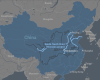
(March 17, 2014) Part two of Lily Kuo’s substantial overview of China’s South-to-North Water Diversion project (SNWDP) and its resettlement process. Kuo notes that since 1949, more than 45 million Chinese have been displaced by infrastructure projects and, of those, 12 million have been moved for water schemes. The water projects, she notes, have a particularly depressing record in terms of outcomes for the resettled. Although there are signs, she says, of villagers moved for the SNWDP receiving better care than those in the past, the same old resettlement problems abound. Worst of all, there are no farms to tend and jobs to do. “This isn’t a life,” says one migrant of the soul-destroying joblessness. “In the morning, you see everyone sleeps in. In the afternoon, they play cards. That’s it.”
Distorted economy dooms China to an “airpocalypse”
(March 4, 2014) With China’s economy operating under perverse incentives, China’s leaders, now assembled in Beijing, will be powerless to clean up its environment.
Talk about following a bad example
(December 24, 2013) As Europe’s carbon market crumbles, China decides it’s time to set one up. On a side note, this has crazy corruption written all over it!
Why China’s renewables industry is headed for collapse
(December 10, 2013) Bankruptcies abound as China’s central planners struggle to keep its green industry from rotting.
China’s great dam boom: A major assault on its rivers
(November 12, 2013) China’s current fever for hydro development is such that even its unparalleled Three Gorges mega-dam now ranks as a mere fraction of its long-term dam agenda, reports Charles Lewis for Yale Environment 360. While China’s need for energy is undisputed, its emphasis on dam construction risks an irreversible legacy of damage the country may never recover from and flies in the face of its present Five Year Plan to develop clean energy, reduce pollution, and protect the environment, says Lewis. Echoing Probe International’s coverage of the innumerable threats posed by construction on such an unprecedented scale, Lewis presents here a valuable and succinct overview of the dangers China’s dam fever represents to its waterways, ecosystems, agriculture and fisheries, traditional livelihoods, species survival and even to its geological stability, as Probe International’s alarming 2012 findings revealed.
Civil disobedience in Sodom – A letter to Xu Zhiyong

(September 18, 2013) Guo Yushan, a longtime friend and colleague of high-profile Chinese human rights activist Xu Zhiyong, penned a grand and robust entreaty to Xu in late July (translated here into English), urging Xu to stand his ground as he awaits trial for “assembling a crowd to disrupt order in a public place.” In reality, Xu, a well-known lawyer and founder of China’s fledgling “New Citizens’ Movement”, had called on officials to disclose their financial assets as it is thought assets disclosure will reveal the true level of corruption among government officials who exploit their political power for personal gain. In his letter, Guo likens Xu to Socrates facing the wrath of Athens and China to the disgraced biblical city of Sodom, and exhorts Xu to rise to his fate as an idealist, unrepentant — “let them charge you, let them torture you”.
Giant landslide likely caused by Xiluodu Dam impoundment, says Chinese geologist
(July 30, 2013) Fan Xiao, a Chinese geologist and chief engineer of the Regional Geological Survey Team of the Sichuan Geology and Mineral Bureau, says analysis of the recent landslide in Yunnan Province indicates that impoundment of the nearby Xiluodu Dam reservoir most likely caused the event and that more can be expected when the reservoir is filled again. Sharply rising or rapidly falling reservoir water levels pose a threat to geological stability, he says, and can trigger disaster.
Farewell, Wu Dengming, “China’s green hero”

(July 25, 2013) Wu Dengming, praised as “China’s green hero” for his tireless dedication to protecting the environment, passed away this month, aged 73. He is remembered here by those who knew and admired him — even those commercial interests he challenged — as a remarkable and devoted advocate to the end.
Beijing social think-tank shut down amid crackdown
(July 20, 2013) On the heels of anti-graft campaigner Xu Zhiyong’s detention, authorities continue to get tough on rights activists as they endure another wallop of repression, shutting down a Beijing-based think tank. The move is seen as payback for activists who have called on government leaders to declare their assets, and on lawyers who defend “sensitive” cases.
 Patricia Adams
 Dai Qing
 Fan Xiao
 Lawrence Solomon
 Mu Lan
 Probe International
 Lisa Peryman
 Probe Media
 Other News Sources


 Probe International