
(June 9, 2010) Amnesty International has condemned Wednesday’s court decision to uphold a five year sentence imposed on a Chinese activist who tried to publicize the number of children who died during the Sichuan earthquake and the corruption that led to their deaths.
It’s official: global warming solutions will destroy the environment
(June 8, 2010) Solutions to solve global warming may actually cause more environmental damage.
Beijing residents worry their city is running out of water, looking to government for action
(June 5, 2010) Three-quarters of those interviewed in a recent survey about Beijing’s water crisis say that they are concerned about the capital city’s water shortages and that they feel pollution and overexploitation of water are to blame. The survey, commissioned by Friends of Nature, China’s oldest environmental organization, was released in Beijing today, World Environment Day.
Trampled under the foot of development: Chinese citizens fight for fair compensation
(June 4, 2010) Chinese citizens being forcefully evicted from their homes are continuing their fight to receive fair compensation from developers and local officials. A month after homeowners were pushed from their homes to make way for the Pubugou dam reservoir in China’s Sichuan province, 700 homeowners in Beijing’s Laogucheng neighbourhood are refusing to leave—even as they face assaults by window-smashing thugs—until they receive fair compensation from a powerful developer.
Three Gorges: Privatizing the profits, socializing the costs
(June 3, 2010) A recent restructuring by China’s Yangtze Power Co., the Shanghai-listed subsidiary of the Three Gorges Project Development Corporation, will see the company acquire full ownership of the only profitable part of the controversial dam—the generators—while assuming little-to-none of the environmental and social costs.
Landslides and seismic activity rock Three Gorges reservoir
(June 1, 2010) As the rainy season arrives and the Three Gorges reservoir is lowered, the controversial project is once again making headlines. This time, it’s because of the increasing number of landslides and seismic activity occurring along the 410-mile long reservoir.
Yangtze! Yangtze! Named one of the best books about water
(May 28, 2010) In a recent interview, Johnny Grimond, a writer-at-large for The Economist said Dai Qing’s “Yangtze! Yangtze!” was one of the best books about water. Mr. Grimond said that Ms. Dai “has written courageously about China’s dams and rivers.”
Nile countries continue fight over water
(May 26, 2010) The countries that share the Nile River basin – Uganda, Ethiopia, Kenya, Tanzania, Rwanda, Burundi and Democratic Republic of Congo – are tired of Egypt, and to a lesser extent Sudan, dictating the terms of the river water’s usage. The upriver countries recently signed a water-sharing agreement more favourable to their interests that then created a diplomatic standoff with Egypt.
Zero responsibility politics, Chinese style
(May 24, 2010) Qian Zhengying, who held office as the Minister of Water Resources for nearly 40 years, admitted in an interview with the Asia Weekly in April that the drought in South Western China and South East Asia was caused by China’s over-exploitation of water resources.
‘Grim situation’ at Three Gorges Dam, Chinese officials warn
(May 24, 2010) With extraordinary candour, Chinese officials are warning that severe rainstorms and gales this month will make efforts to prevent landslides in the Three Gorges dam area “formidable.”
Dams damaged in Yushu earthquake
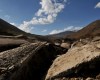
(May 22, 2010) The April 13, 2010 Yushu earthquake damaged three dams on the Batang River, putting one at risk of collapse.
Chemical reactions on the Yangtze
(May 17, 2010) In the rolling hills alongside the Three Gorges reservoir, on a Tiananmen Square-sized plot of land, stands a sign marking the site of an “Integrated MDI Project” in the village of Baishi. On completion, this will be home to the world’s largest Methylene diphenyl diisocyanate plant and the villagers all know that German chemical giant BASF is on the way.
Hot wind in the desert
(May 13, 2010) The Chinese county of Guazhou, in north-western China, is famous for its honey melons. But it also produces wind. It blows in from the east through the high, narrow valley formed by the Qilian and Beishan mountains, on the southern edge of the Gansu Corridor.
China’s earthquake watcher
(May 12, 2010) An article about Yong Yang, a rabble-rousing independent geologist who has previously faced death threats from businessmen and local officials for raising concerns about the feasibility of lucrative proposed projects.
Clean energy’s dark side: safety of “green” dams in China called into question
(May 11, 2010) Dams are often presented as a clean source of energy. But, as Heather Gingerich, Probe’s Medical Geologist-in-Residence and current Director of the International Medical Geology Association in Canada, explains, they can trigger earthquakes.
 Patricia Adams
 Dai Qing
 Fan Xiao
 Lawrence Solomon
 Mu Lan
 Probe International
 Lisa Peryman
 Probe Media
 Other News Sources


 Probe International