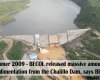
The Inter-American Commission on Human Rights has given the government of Belize three months to respond to allegations filed 12 years ago by BELPO, an organization representing the Maya people and affected communities.

The Inter-American Commission on Human Rights has given the government of Belize three months to respond to allegations filed 12 years ago by BELPO, an organization representing the Maya people and affected communities.

More than 10 years after its completion in September 2005, the Americas’ official human rights watchdog has opened a case against the government of Belize to consider the impacts of the country’s long controversial, Canadian-owned Chalillo dam.
A CIDA-funded teacher-training project based in Pakistan’s Sindh province has been revealed as nothing more than a cash cow by a former project leader who claims teacher training took place only on paper and that while those registered were often unaware they were signed up to the programme, their training expenses were pocketed by officials.

(January 17, 2014) Haiti’s post-earthquake disaster housing projects are either empty and looted, or taken over by squatters and people unaffected by the 2010 earthquake. Why? “There is a void…there is no authority there.”
(August 20, 2013) The World Bank and Canada’s Department of Foreign Affairs, Trade and Development have banned Canadian engineering giant SNC-Lavalin from bidding on aid contracts. But that hasn’t deterred the Canadian federal department of Public Works from awarding a lucrative defence contract to a subsidiary of the corruption-plagued SNC-Lavalin company.
(August 3, 2013) A little-known Crown corporation is doing what it can to help corruption-plagued SNC-Lavalin get a lucrative contract in Trinidad and Tobago.
(June 13, 2013) The New York state Public Service Commission unanimously approved the $1.5 billion bid by Canadian-based Fortis Inc. to take over Central Hudson Gas & Electric Corp.’s parent company, CH Energy Group despite “fierce public hostility.” Commission Chairman Garry Brown warned Fortis to avoid looking at the local utility as a profit-generating holding. “Get to know New York,” he advised Fortis. “The way you may do things, business, elsewhere is not New York,” in a probable reference to Fortis’s controversial record of dam-building in Belize.

(April 2, 2013) Now-abolished foreign aid pork barrel won’t be missed. Patricia Adams’ epitaph for CIDA.
(December 8, 2011) The Asia Pacific Foundation of Canada held an online conversation on the question: is there a “best way” for Canada to promote human rights in Asia? Patricia Adams of Probe International says that there is: by “getting its own house in order and ensuring that Canada does not aid and abet abuses abroad.”
(January 17, 2011) Probe International obtains internal CIDA documents that show the aid agency failed to detect the fraudulent use of its funds in Zambia.
(December. 23, 2010) Canada’s foreign aid agency once again finds itself in the middle of a corruption scandal involving its funds.
(November 15, 2010) A corruption scandal in Zambia involving top officials in the Health Ministry has links to Canadian foreign aid, writes Brady Yauch.
(March 14, 2010) Since 2006, Canada has poured $15-million in government money into a massive foreign campaign against the sexual violence in Congo. But Ms. Bihamba, who as leader of a women’s group spent lonely years speaking out against the problem, is now one of a growing number of skeptics who question whether this money is achieving its goals.
(December 18, 2009) Foreign aid is facing more criticism this time from an official at the United Nations Millennium Campaign. According to a recent report in the Guardian UK, Sylvia Mwichuli, the UN millennium campaign communications coordinator, told an audience attending a media workshop that governments in Africa must look for different ways to finance their national budgets, rather than relying on foreign aid.
(November 20, 2009) A recent article from Canwest details the sharpening criticism facing Afghanistan President Hamid Karzai from foreign leaders, including U.S. President Barack Obama, British Prime Minister Gordon Brown and Prime Minister Stephen Harper, concerning the country rampant corruption. But the article does little to confront the ugly reality that the massive amount of foreign aid entering Afghanistan may be playing a crucial role in supporting rampant corruption.



 Patricia Adams
 Dai Qing
 Fan Xiao
 Lawrence Solomon
 Mu Lan
 Probe International
 Lisa Peryman
 Probe Media
 Other News Sources
 Probe International