
(June 27, 2013) The Kerala High Court has directed India’s Central Bureau of Investigation (CBI) to divide the SNC-Lavalin trial charge sheet so the trial can begin. Two of the nine accused, SNC-Lavalin VP Klaus Triendl and SNC-Lavalin itself, have failed to appear in court despite several summons. According to press reports, Indian authorities are now seeking the extradition of Mr. Triendl, but Canada’s Department of Justice won’t confirm or deny the existence of the extradition request “due to the confidential nature of state-to-state communications.”
Deadly earthquake in China may be aftershock of 2008 Wenchuan quake
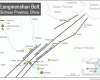
(April 21, 2013) The strong earthquake that struck China’s mountainous Sichuan province Saturday morning may have been an aftershock, says prominent Chinese geologist, Fan Xiao. The accumulation of stress had not yet been fully released, making this region a more dangerous area after the May 2008 Wenchuan earthquake.
SNC-Lavalin executive reveals illegal political donations before corruption inquiry
(March 15, 2013) A vice-president from SNC-Lavalin, Canada’s largest engineering company, admitted yesterday before Quebec’s Charbonneau inquiry into corruption in public-works contracts, that it organized its employees to make more than $1 million in illegal political donations. While there was no direct link between the donations and a quarter-billion dollars in contracts the firm was awarded by the provincial government, Yves Cadotte insisted, the company did not want to take any chances.
Press Release: Export Development Canada bound by no rules on the environment file
(February 13, 2013) EDC environmental decisions virtually immune from judicial review. Crown corporation sets standards and can exempt projects on its own say so.
Corruption, bribery, baksheesh! Rooted in government
(February 6, 2013) Foreign Affairs Minister John Baird has announced get-tough-on-corruption amendments to the Corruption of Foreign Public Officials Act (CFPOA). Pat Adams, head of Probe International in Toronto, sees the announcement as Canada’s response to pressure from the Organization for Economic Co-operation and Development (OECD). “Canada is supposed to report back on deficiencies in its anti-corruption laws by March of this year. This appears to fix the deficiencies,” she says.
SNC-Lavalin corruption case: new court date set but plea for speedy trial dismissed
(January 28, 2013) India’s Central Bureau of Investigation (CBI) told its special court last month that two of the accused in the notorious SNC-Lavalin hydro-dam graft case were “interfering” with the court’s decision to secure the presence of Klaus Triendl, the former vice-president of Canadian engineering giant SNC-Lavalin and the sixth accused in the case. The two accused in question had requested the charge sheet be divided in order to facilitate the speedy trial of those who had already answered the summons of the court in connection with the case. The court has since dismissed their plea, however, saying there was no reason to think that the presence of Triendl could not be obtained within a reasonable time and set April 24, 2013 as the new date to hear the corruption case.
Immunity from scrutiny: Canada’s Access to Information Act hobbles democracy
(January 7, 2013) Canada’s Access to Information Act perversely gives Export Development Canada (EDC) the legal power to keep records of its operations secret, charges Probe International. In its submission to the Office of the Information Commissioner’s review of Canada’s 30-year-old Access to Information Act, Probe International declares it is time to reform the Act and remove EDC’s extraordinary privileges.
A respite for Patagonia
(July 4, 2012) Chile’s HidroAysén mega-dam scheme is suddenly on hold as one of the owners of the controversial dam scheme suspends its support for the risky project.
Geology expert Yang Yong on the challenges facing China’s most controversial dam projects

(January 5, 2012) Yang Yong on the future of river management in China and the issues currently facing the country’s more controversial dam projects.
The best way to promote human rights in Asia
(December 8, 2011) The Asia Pacific Foundation of Canada held an online conversation on the question: is there a “best way” for Canada to promote human rights in Asia? Patricia Adams of Probe International says that there is: by “getting its own house in order and ensuring that Canada does not aid and abet abuses abroad.”
EDC releases internal documents to Probe International under Access to Information, but reveals little: UPDATE
(February 27, 2009) Heavily censored data keeps tight lip on Canadian investments in Chile.
Protests after Chile backs giant dams in Patagonia’s valleys
(May 10, 2011) Activists fear ecological haven will be destroyed but government says project is vital for economic growth
Chileans protest government approval of five Patagonia dams
(May 10, 2011) Dam projects are drawing increased criticism in South America, which boasts three of the world’s four biggest hydroelectric dam complexes. Chile is pushing forward with a $7 billion dam project.
HidroAysen Patagonia Dam Project Awaits Government Approval
(May 9, 2011) The HidroAysen dam project in Patagonia is awaiting government signoff.
Memo to Chinese government: no one believes you
(April 15, 2011) Patricia Adams writes: Chinese authorities will invent crimes, if need be, to silence dissidents for exercising their right to freedom of speech. However, renewed efforts to curb criticism and protest reveal an entrenched public distrust towards the government: the people of China, and the world, are done listening.
 Patricia Adams
 Dai Qing
 Fan Xiao
 Lawrence Solomon
 Mu Lan
 Probe International
 Lisa Peryman
 Probe Media
 Other News Sources


 Probe International