
An Interview with Liu Haiou: China Unofficial Archives.
By Shu Fan
This article was first published by the China Unofficial Archives.
Summary by Probe International
Author Liu Haiou, known by her pen name Ling Zhi, is well known for her writings on China’s Cultural Revolution, an experience that she lived through as an active participant in the Mao Zedong era of brutal transformation. Strikingly, Liu is able to illuminate a time of mass mobilization and ideological frenzy with rare wit, detachment, and visual honesty, combining text and comic strips to explore how ideology can hijack the human soul.
Liu’s narrative of youth in her autobiographical work, My Forty Years in China, composed of 640 comic strips, recalls everyday life during an extraordinarily tumultuous period. One drawing shows a teenage girl reciting quotes on class struggle while thoughts of Mozart and his compositions call her elsewhere. To silence the dichotomy, the girl visualizes pointing a gun at the composer.
The scene resonates for people who learned to distrust their own thoughts and feelings in service of the “revolutionary collective” and its erasure of self. Women faced compounded humiliation—political persecution layered with body-shaming, further crushing personal dignity. The lasting conflict Liu unpacks, especially for older generations, is the difficulty in reclaiming an inner life after surviving a profound assault on the human spirit.
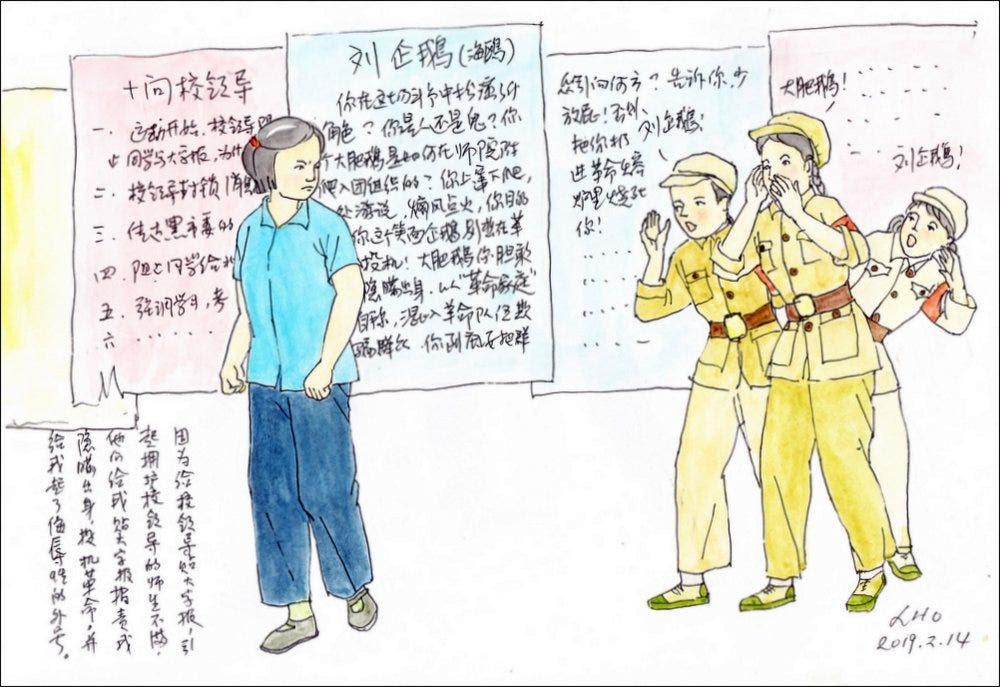
Liu’s work shines a light on the generational trauma for societies that allow politics to devour morality, individuality, and truth. Even after the Cultural Revolution was officially denounced, the same system could attempt to force a late-term abortion under the One-Child Policy. The machinery that treated people as instruments of political will remained in place.
When witnesses die and records are destroyed, truth becomes second-hand or unbelievable to those who never lived it. Liu’s decision to create a comic-format memoir was explicitly to reach her daughter and future generations who might otherwise dismiss the events as fiction.
Liu traces the Revolution’s rapid engulfment of society to deep-rooted Chinese cultural tendencies: blind worship of authority, herd-following behavior, either/or moral judgments, and a pragmatic “survival-first” rationality. These patterns made the population highly susceptible. Echoes appear today, she says, in online fervor, rapid shifts in public opinion guided by official narratives, and the ease with which individuals can be mobilized against designated “enemies” or deviants.
In conversation with writer Shu Fan for China Unofficial Archives, Liu looks at the current nostalgia for the Cultural Revolution led by youth searching for meaning, equality, and purpose—similar longings that once animated the Red Guards. Without an honest reckoning of what actually happened, she says—the beatings, the suicides, the destroyed families, and the moral wasteland left behind—the cycle of illusion and disillusionment risks repeating in new forms.
Ultimately, Liu’s message is one that champions the need for private space, independent thought, beauty, and moral intuition as one of the best defenses against ideological capture. Those defenses somehow endured in Liu to resist the self-annihilation of collectivism. Writes Shu:
“Reading [Liu’s] life chapter by chapter, I was frequently moved to laughter. At times, her tone resembles the female stand-up comedians I admire: witty, sharp, hitting the mark with lightning speed. She employs a humorous narrative voice while maintaining the independent, detached perspective of a writer. I find this quality exceptionally rare among those who grew up in the Cultural Revolution—an era that did not encourage anyone, least of all women, to maintain an independent viewpoint. In an age that demanded the total erasure of individuality in favor of the collective, she never fully lost herself, and she has captured that struggle in both words and drawings.”
中国民间档案馆 China Unofficial Archives is a reader-supported publication dedicated to digitizing and preserving censored, underground, and independent Chinese historical materials. It provides open-access books, magazines, and films covering topics often omitted by official narratives, such as the Great Famine and the Cultural Revolution.
Categories: Voices from China



