
Should extra-large bridges be built in geologically unstable areas? Basic Common Sense would like to know.
Theoretically, “megabridges” are ultra resilient with lifespans of 50 to 100 years. Even so, safety incidents can and do occur, albeit infrequently. As the world leader in megabridge construction, the unexpected collapse of three such structures in China this year raises significant concerns about the implications for public safety, particularly in areas prone to geological disasters. As his handle implies—“basic common sense”—this Chinese blogger has questions regarding megabridge risks.
Author: Basic Common Sense | Source: NetEase
原文链接: https://www.163.com/dy/article/KEC4J1KI0553H12T.html?f=post2020_dy_recommends
Simplified English via Google Translation
“Megabridge” is an architectural term that refers to bridges with a single hole span of more than 150 meters or a multi-hole span of more than 1,000 meters, which is the highest level in the bridge classification.
In short, it is the largest and most majestic batch of bridges. Correspondingly, it must also be the type of bridge with the highest adherence to technical standards and the strictest construction quality requirements.
Theoretically, it should also be the least likely bridge to collapse.
[Edited for clarity] Mega-bridges cost hundreds of millions or even billions to build. Even if corruption has drained a large portion of the budget, there should still be enough money left to build a bridge—regardless of whether it falls within the category of ‘tofu-like’ substandard projects—that at least resembles firm frozen tofu, not crumbly tofu dregs. (In other words, even if the bridge isn’t top quality, its main structure should hold together like frozen tofu rather than disintegrate like tofu dregs when it collapses. At the very least, the core structure shouldn’t crumble into pieces).
Of course, there will always be a gap between reality and theory, and safety accidents on megabridges occasionally occur, but they are extremely rare. Therefore, every time a safety accident occurs on a megabridge, it will definitely attract the attention and responsibility of the safety supervision department, and it will definitely become hot news.
But the strangest thing is that such a rare safety accident as the collapse of the megabridge has occurred three times so far in 2025.
Below: The approach bridge of the Monkey River Bridge in Guizhou collapses.
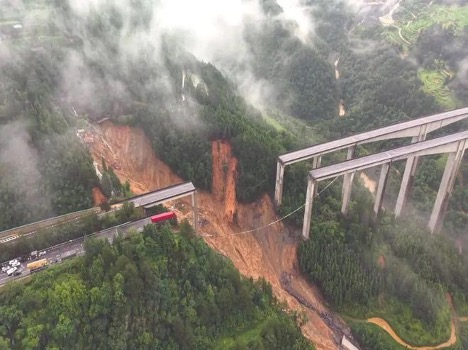
On June 24, 2025, the Houzihe Bridge in Sandu County, Guizhou Province, collapsed. Fortunately, the driver of [a] truck [leading traffic] braked in time, preventing any casualties. Traffic control measures were implemented after the anomaly was detected, stopping more than 200 vehicles.
The main span of the Monkey River Bridge is 220 meters, and the piers are 135 meters high, equivalent to a 40-story building.

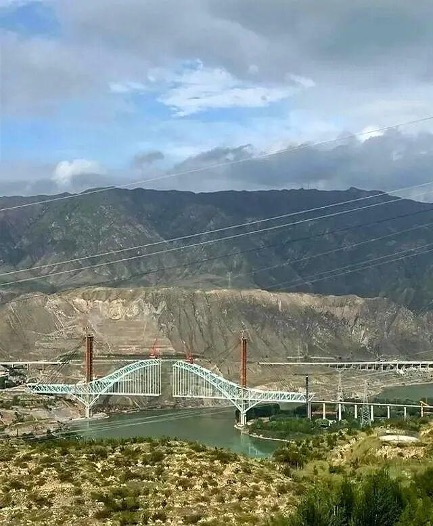

On August 22, 2025, the Yellow River Bridge in Jianzha County, Qinghai, while still under construction and about to be opened to traffic, collapsed, killing 12 people and leaving four people unaccounted for.
The bridge is designed to have a total length of 1,596.2 meters, a main span of 366 meters, and an investment of 436 million yuan.
On November 11, 2025, the Hongqi Bridge in Malkang City, Aba Prefecture, Sichuan Province [partially] collapsed. Due to an abnormality found during an inspection before the accident, traffic control was implemented, and the collapse [of the approach span and a section of the structure] did not cause casualties.
The Hongqi Bridge has a total length of 758 meters, a main span of 220 meters, and an investment of more than 300 million yuan.

The bridge closed in January this year, opened to traffic in April, and [partially] collapsed in November […] at the age of less than one year.
Of course, two of the above three collapsed bridges were accidents caused by landslides, which cannot be generalized as tofu dregs projects or liability accidents.
As a layman, I have three questions based on simple cognition and basic common sense:
First, should extra-large bridges be built in areas with geological disaster risk measures?
Second, if there is a certain probability of a large geological disaster that bridges cannot resist, is it not so suitable for building extra-large bridges, or even bridges?
Third, China has built the world’s largest number of megabridges. Among the top ten tallest bridges in the world, the top eight are in China—the country’s highest, Guizhou Huajiang Canyon Bridge, is 625 meters high. Do we as travelers need to worry extra about it?
Asking a professional for advice.
Categories: China's Dams, Dams and Landslides, Three Gorges Probe
 Patricia Adams
 Dai Qing
 Fan Xiao
 Lawrence Solomon
 Mu Lan
 Probe International
 Lisa Peryman
 Probe Media
 Other News Sources


 Probe International