
Decades-old infrastructure strains under demand. Experts warn new fixes won’t address systemic flaws.
By Probe International and Three Gorges Probe
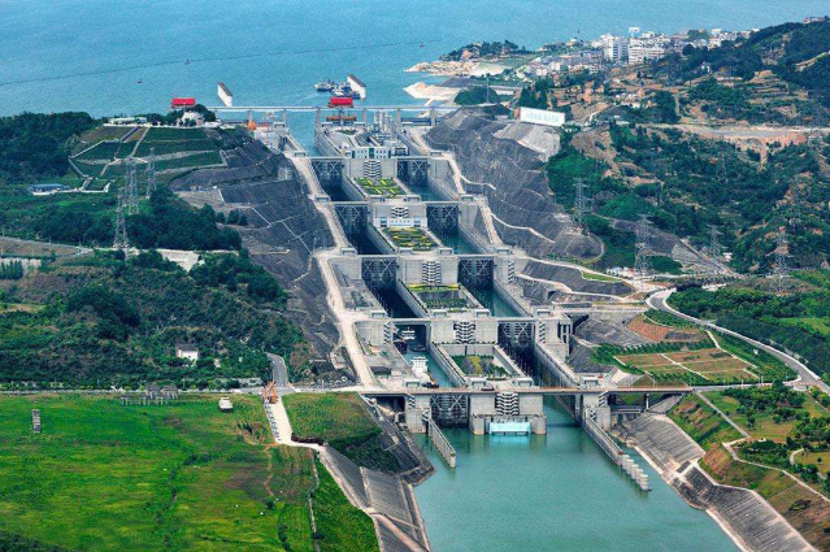
The Three Gorges Dam’s existing five-tier ship lock system, operational since 2004 and hailed as the world’s largest and most complex, is faltering under surging Yangtze River traffic. Demand has pushed the aging infrastructure beyond its designed capacity, exposing critical strain on its operations.
Built by the People’s Armed Police Force (PAP), beginning in 1994 over nine years, the locks now face structural vulnerabilities and severe congestion, with vessels enduring wait times exceeding 10 days to traverse the dam. A new, larger ship lock—part of China’s 14th Five-Year Plan—aims to alleviate bottlenecks, but experts warn the lock alone cannot resolve systemic flaws in the dam’s navigation.
Approved by the National Development and Reform Commission (NDRC) at the end of May, the estimated dimensions for the “New Three Gorges Shipping Channel Project,” included in China’s 14th Five-Year Plan, run to 6,680 meters in length, a width of 40 meters, and a depth of 8 meters, eclipsing the original structure at 6,400 meters long, 34 meters wide, and 5 meters deep. While both the existing locks and the new lock share a dual-channel, five-step design, the latter’s upgraded chambers with deeper water in each step are designed to boost capacity. Yet structural concerns linger: Wang Weiluo, a German-based hydrology expert, revealed to Three Gorges Probe that the original locks suffer from tilted slopes and significant quality issues, necessitating urgent infrastructure expansion.

Traffic Surge Overwhelms System
Freight volume through the Three Gorges Dam (22,500 MW)—operated jointly with the much smaller Gezhouba Dam (2,715 MW)—has skyrocketed since 2003, bumping to 174 million tons in 2023, far exceeding the dam’s original projections. According to data from the Three Gorges Navigation Authority, since opening in 2003, the Three Gorges ship locks have recorded a cumulative freight volume of 2.24 billion tons, 215,000 lock operations, more than 1.074 million cargo vessels, and over 12.291 million passengers. In its approval, the NDRC described the Three Gorges-Gezhouba hub as a key node for the development of shipping on the Yangtze River.1
By 2011, Three Gorges’ cargo traffic had already outpaced design limits by 20%, with upbound tonnage reaching 60.29 million tons against a 50-million-ton capacity. Wait times have spiraled from 17 hours in 2011 to more than 200 hours (8+ days) in 2024, despite a slight dip in throughput last year due to maintenance-related closures (the north line of the Three Gorges ship lock and the No. 1 lock at Gezhouba were shut down for inspection and repairs for 45 days, with the Gezhouba lock further on hold for 18 days for flood season operations).2
The new Three Gorges navigation channel is essentially a ship lock that runs parallel upstream to downstream in relation to the existing ship lock [refer to the maps below]. The project represents the largest integrated infrastructure for the Yangtze River since the original dam’s completion.
Another undertaking in tandem to the new Three Gorges ship lock involves the Gezhouba Shipping Capacity Expansion Project, to be located on the left side of the existing Gezhouba Dam (downstream of Three Gorges). This targets the Gezhouba Dam’s aging No. 3 ship lock, which will be demolished and replaced with two modern lock lanes mirroring the Three Gorges specifications.
Classified as a Class I waterway,3 each chamber of the reconstructed ship lock will match the new channel’s dimensions (280m x 40m x 8m) to accommodate the transit of large (10,000-ton) cargo ships.

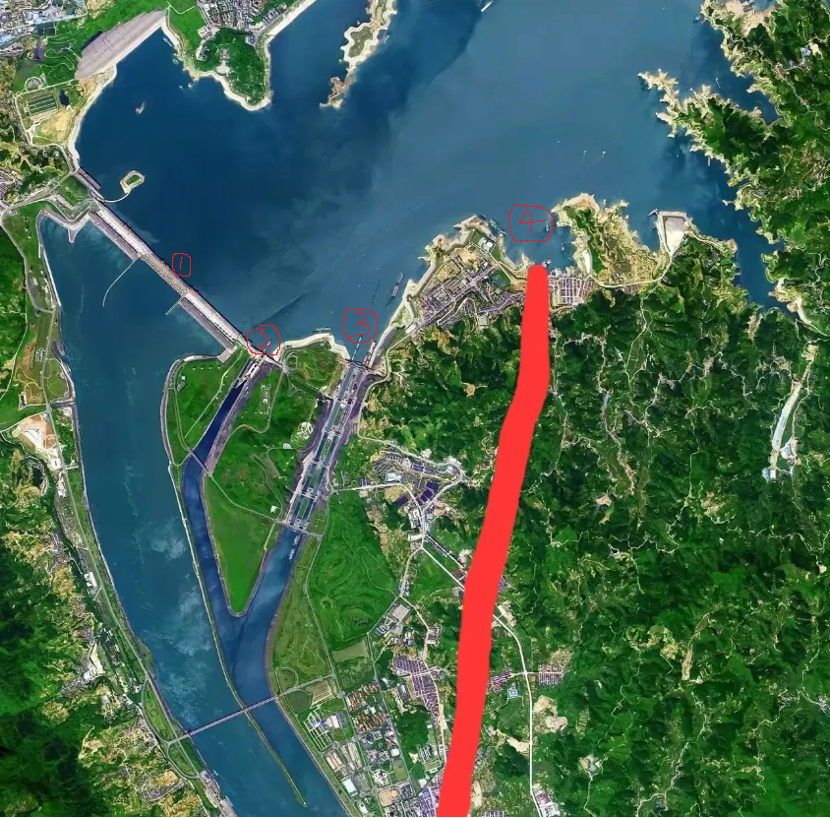
A closer look: from 1-4, (1) The Three Gorges Dam; (2) the ship lift; (3) the existing ship lock; (4) the proposed new shipping channel.4
Unmet Promises and Persistent Challenges
The dam’s proponents, including Deng Xiaoping-era planners, once vowed 10,000-ton barges would sail unimpeded from Shanghai to Chongqing—a vision yet to be achieved. Hydrology expert Wang Weiluo identifies three crucial hurdles that must also be addressed:
Low Bridge Clearances: Critical sections of the Yangtze lack vertical space for large vessels.
Shallow Jingjiang Stretch: Seasonal shallows in the Jingjiang section—a critical area for shipping and flood management—located downstream of the Three Gorges Dam. This section is characterized by a winding course, an unstable riverbed, and frequent shoal changes. Three Gorges was, in part, designed to mitigate flood risks in this flood-prone section through regulation of water flow from upstream.
Insufficient Reservoir Depth: For half the year, the Three Gorges Reservoir navigation channel cannot sustain heavy shipping.
While China’s 14th Five-Year Plan includes a “New Three Gorges Shipping Channel” feasibility study for the Three Gorges Dam, officials have not disclosed cost estimates or timelines. The existing locks, despite moving 2.24 billion tons of cargo since 2003, remain the “weakest link” of the Three Gorges, says Wang. A study conducted by the NDRC shows that by 2030 and 2050, demand for lock passage at Three Gorges will reach 230 million tons and 260 million tons, respectively—far exceeding the maximum capacity of the existing ship locks, which can only be stretched to 170-180 million tons.
The new ship lock underscores China’s urgency to salvage Yangtze commerce, but systemic fixes—from dredging to bridge modifications—are critical to reviving the dam’s original ambitions. As Wang warns, building a bigger lock alone won’t enable the goal of 10,000-ton-class ships to travel directly from Shanghai to Chongqing. For now, the Yangtze’s navigation crisis remains a turbulent passage.
1 The Gezhouba Dam is located at the lower end of the Three Gorges in Yichang City, Hubei Province (38km downstream of the Three Gorges Dam). Construction of Gezhouba began in December 1970 and ended in December 1988.
2 These numbers are from the article: “The Three Gorges-Gezhouba Dam complex has become a choke point for Chongqing’s development” posted on Tencent News by BaiYiHaiDao (白衣海盗) on June 10, 2025. See: https://news.qq.com/rain/a/20250610A020VL00.
3 According to China’s Inland Waterway Navigation Standards, waterway classification is based on the maximum vessel tonnage capacity, typically divided into seven classes (I to VII). These correspond to vessels of the following capacities: 3,000 tons, 2,000 tons, 1,000 tons, 500 tons, 300 tons, 100 tons, and 50 tons respectively. The higher the level of the navigation channel, the more capacity it can support in terms of vessel capacity, necessitating more stringent requirements for water depth, width, and other conditions for ease of navigation.
4 The original map is from a post by FenXiangFuQin (焚香抚琴) on the site of JinRiTouTiao (今日头条). Follow the link.
Main image created by Generative AI.
 Patricia Adams
 Dai Qing
 Fan Xiao
 Lawrence Solomon
 Mu Lan
 Probe International
 Lisa Peryman
 Probe Media
 Other News Sources


 Probe International
1 reply »