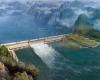
A two-day symposium focused on China’s Three Gorges Dam convened scientists and experts from China and elsewhere for a post-project assessment of the world’s largest hydro dam at the University of California, Berkeley.

A two-day symposium focused on China’s Three Gorges Dam convened scientists and experts from China and elsewhere for a post-project assessment of the world’s largest hydro dam at the University of California, Berkeley.
(April 20, 2012) A report by the environmental group Probe International shows 20 dams in the upper Yangtze are in seismically active territory. But moving citizens could take some convincing. Those who have been relocated for the Three Gorges Dam have experienced trouble getting settled and finding work.
(April 19, 2012) Around 20,000 residents from the vicinity of China’s massive Three Gorges Dam face relocation because their homes are at risk from “constant landslides.” Patricia Adams, editor of online news portal Three Gorges Probe, writes: “Twenty years later, the critics have been proven right on all counts.”
(April 17, 2012) Twenty years ago this month, China’s epic Three Gorges Dam received construction approval from the Chinese government, with the blessing of a Canadian government report: both governments stood to benefit from the ill-conceived state vanity project at great cost to many. Probe International’s Patricia Adams looks back at how the symbol of China’s ‘rise’ has become an omen of all that is wrong with China and why a country like Canada would inflict such risks on citizens elsewhere.
(April 10, 2012) Three international environmentalist activists, each an outspoken pioneer in challenging conventional assumptions about water use, share their insights and experience. Featuring Probe International’s Patricia Adams and Dai Qing.
(April 12, 2012) Patricia Adams discusses a new report commissioned by Probe International in today’s Huffington Post Canada.
(March 27, 2012) Fears over climate change and the potential for profit are behind a dam-building boom in China that, without public oversight, is running roughshod over the country’s environmental legacy and the livelihood of its people. Property rights must be respected, says the author of a new report.

(March 27, 2012) Probe International is cosponsoring an upcoming two-day symposium on the impacts of the Three Gorges Dam with the Department of Landscape Architecture and Environmental Planning, at the University of California, Berkeley. The symposium will gather scientists and experts from China, and elsewhere, to discuss emerging problems with the world’s largest electricity-generating plant in order to mitigate harm and to inform future investments in China’s power sector. The symposium will be held on April 13th and 14th, at Wurster Hall, University of California, Berkeley.
(December 13, 2011) The Durban climate conference set out to save the planet, but in the end may only save China’s green energy industry and the EU’s carbon markets, both of which are in danger of freefall. The $100-billion a year Green Climate Fund, agreed to by the conference, will finance the global spread of Chinese technologies. And the EU’s unilateral decision to extend Kyoto will help prop up its faltering carbon markets. But beyond December 2012, when the current Kyoto Protocol ends, the EU will be on its own as Canada, Japan, and Russia have declared their intention to withdraw.
(November 28, 2011) China’s Academy of Social Sciences says the Three Gorges Dam is not to blame for this year’s devastating drought. That is wrong, says Probe International’s Patricia Adams, who explains why Three Gorges is making downstream water shortages a chronic problem.
Myanmar’s announced cancellation of the Myitsone dam on the Irrawaddy River has brought long-standing tensions with China into the open – including setting off conflicts with the Kachin Independence Organization in the north of the country. “It may be that the Myanmar government sees Chinese investment, in particular the Myitsone dam, as a destabilising force,” said Patricia Adams.
(August 18, 2011) “The Yangtze River will run dry” because engineers have gone wild, building so many dams that the amount of water needed to fill all the reservoirs along the Yangtze would exceed the flow of the river. So says “A Mighty River Runs Dry,” a new study by geologist Fan Xiao of the Sichuan Geology and Mineral Bureau in China. Because there isn’t enough water in the Yangtze to fill all the dams to their designed capacity during the impoundment period each year, “an enormous waste of money” will result, with potentially staggering losses to China’s economy, 40 per cent of which comes from agriculture, fishing, industry and shipping along the Yangtze.
(July 4, 2011) Probe International’s Patricia Adams joined a Business News Network (BNN) panel to discuss the dangers of corporations wishing to do business in China given its poor human rights record.
(June 24, 2011) China is heading for a degree of government ownership and central planning unseen since Mao’s passing. This Financial Post article by Probe International’s Patricia Adams looks at the advance of the state at the expense of China’s private sector and its foreign competition. In fact, she notes, western companies – feeling unwanted – are beginning to pull up stakes in China. And that suits China just fine.
(June 1, 2011) A study by seismologists at the China Seismological Bureau indicates that the massive Three Gorges dam on the Yangtze River caused a “significant” increase in seismic activity along the dam’s reservoir.



