
(April 7, 2014) Chinese geologist and environmentalist Fan Xiao says the recent quakes that struck central China’s Hubei Province in Zigui county — “the first county of the Three Gorges Dam” due to its proximity to the project site — signal that the seismic threat posed by Three Gorges Dam is at its most critical stage now. Reservoir-induced seismicity (RIS) is most likely to occur within a few years, even a decade after initial filling of a dam reservoir to its highest level, due to the time it takes for reservoir water to penetrate deep into seismic faults and fissures before it triggers seismic activity. A 2010 study revealed seismic monitors around the Three Gorges Dam reservoir and in Hubei Province registered 3,429 earthquakes between June of 2003 (when inundation of the reservoir began) and December 31, 2009: a 30-fold increase in seismic frequency over the pre-dam period.
Still fighting for compliance: Belize’s Macal River
(April 5, 2014) A letter to the editor expresses concern at the lack of response from Belize authorities to environmental lawyer Candy Gonzalez’ public campaign for government bodies to implement a risk management program for the controversial Canadian-owned Chalillo dam on Belize’s Macal River. In particular, the monitoring and testing of mercury levels in fish caught in the Macal and E. coli levels in the river’s water. Writes concerned villager, John Tut: “It seems that the Government of Belize has once again abandoned the well-being and livelihood of the Cayo people in favour of the monstrous multinational company – BECOL [the non-regulated hydroelectric generation business that operates the Chalillo dam, a subsidiary of dam owner, Canadian company, Fortis, Inc.].”
More earthquakes strike Three Gorges Dam region
(April 1, 2014) A magnitude-4.7 earthquake hit Zigui county in central China’s Hubei Province last Sunday, around 23 kilometres from the Three Gorges Dam site location, several days after a magnitude-4.3 tremor was felt early Thursday morning about 30 kilometres from the dam. Authorities say the dam was not affected but they are monitoring the situation. There have been no reports of casualties or property damage, although news coverage has noted an increase in Chinese experts who support the speculation that the project itself is the cause of local seismic activity.
Senior official of State Council died from falling off building
(April 1, 2014) Li Wufeng, the high-level Chinese minister who died after falling from the 6th floor of his office last month, once briefly served as the assistant general manager of China Three Gorges Project Corporation (CTGPC), the recent target of a two-month corruption probe that angered the Chinese public with its revelations of bidding irregularities, bribery and excessive spending by corporation officials. Li’s sudden death has caused much speculation. A CTGPC insider is quoted in this report as saying meddling by CTGPC leaders and their families in bidding for company projects and interest transfers was an “open secret” and that “even individual retired cadres were involved in the countless corruptions. Now everyone at the CTGPC is in a panic, because everyone was involved.”
Three Gorges Dam not affected by tremor
(March 28, 2014) Once again, an earthquake has hit the Three Gorges reservoir area and dam officials are reassuring the public that the world’s largest hydropower plant is operating normally. The epicenter of a 4.3-magnitude earthquake struck Zigui County, just 30 km from the Three Gorges Dam at 12:20 a.m. March 27, 2014. Stay tuned while Probe International investigates the cause and effect of this latest tremor.
China Three Gorges Corp bosses replaced after graft probe
(March 26, 2014) China’s central government replaces leadership at state-owned Three Gorges Corp. following graft probe. Signals suggest “it is probable there will be further investigations into corruption inside the corporation,” says Probe International’s Patricia Adams.
Governments rip up renewable contracts
(March 19, 2014) Companies ‘do not have a right [to expect the compensation] not to be changed.’
Beware the “economic fundamentals” of politically-backed companies
(March 19, 2014) A corruption scandal in China involving the country’s largest, state-backed oil companies has some analysts talking about a “buying opportunity”, but investors would be right to proceed with caution.
Bangladesh waiting on Canada to try SNC-Lavalin officials in corruption case
(March 18, 2014) Regulators in Bangladesh have put an investigation of corruption allegations involving SNC-Lavalin in that country on hold until a trial in Canada involving former employees of the engineering giant is […]
China is so bad at conservation that it had to launch the most impressive water-pipeline project ever

(March 17, 2014) Reporter Lily Kuo takes an in-depth look at China’s South-to-North Water Diversion project — the world’s largest water diversion conceived originally by Mao Zedong as a way to relieve North China’s dwindling water resources by “borrowing” from the south of the country. But not even the project’s leaders are pretending the mammoth, ultra-complex, $80-billion scheme will solve China’s water problem. Moreover, it has already created extra problems. Kuo concludes the project is another example of an engineer-dominated government’s fondness for huge-scale vanity projects with a particular weakness for mega-water works. No wonder. Without the man-made institutions — a robust regulatory regime and the rule of law — the Chinese government is bereft of tools to induce the efficient use (and conservation) of water. And so it builds canals and moves water from one watershed to another, creating havoc and perpetuating the problem of China’s crippling water crisis.
China’s desperate need for water is forcing the relocation of hundreds of thousands of people
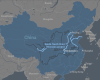
(March 17, 2014) Part two of Lily Kuo’s substantial overview of China’s South-to-North Water Diversion project (SNWDP) and its resettlement process. Kuo notes that since 1949, more than 45 million Chinese have been displaced by infrastructure projects and, of those, 12 million have been moved for water schemes. The water projects, she notes, have a particularly depressing record in terms of outcomes for the resettled. Although there are signs, she says, of villagers moved for the SNWDP receiving better care than those in the past, the same old resettlement problems abound. Worst of all, there are no farms to tend and jobs to do. “This isn’t a life,” says one migrant of the soul-destroying joblessness. “In the morning, you see everyone sleeps in. In the afternoon, they play cards. That’s it.”
EDC’s involvement in Gaddafi’s Libya silenced until fall
(March 10, 2014) Export Development Canada says it needs nearly a year to sort through a mountain of documents regarding its involvement in Libya.
Distorted economy dooms China to an “airpocalypse”
(March 4, 2014) With China’s economy operating under perverse incentives, China’s leaders, now assembled in Beijing, will be powerless to clean up its environment.
Fighting for compliance again: Belize’s Macal River
(February 28, 2014) Candy and George Gonzalez from the Belize Institute of Environmental Law and Policy (BELPO) — longtime champions of Belize’s Macal River and active monitors of the controversial Canadian-owned Chalillo dam and its impacts on the river — say they are again trying to press various Belize government departments to adhere to the Environmental Compliance Plan agreed to for the project. Under the plan, the Macal’s water and fish require regular testing and the results published to protect public health and safety. At present, the Gonzalez’s say public health is in danger from high mercury levels in fish caught in the Macal and high levels of E. coli in the river’s water, but the departments responsible for implementing the project’s risk management program are not doing their job.
SNC-Lavalin facing allegations of kickbacks in Canada
(February 21, 2014) SNC-Lavalin, the Montreal-based engineering giant, is facing more allegations of corruption.
 Patricia Adams
 Dai Qing
 Fan Xiao
 Lawrence Solomon
 Mu Lan
 Probe International
 Lisa Peryman
 Probe Media
 Other News Sources


 Probe International