
(June 27, 2010) Probe International’s Executive Director Patricia Adams participates in a debate on the effectiveness of foreign aid. The debate originally aired on BNN.
Letter to Mekong River Commission by Save the Mekong Coalition
(June 15, 2010) A letter from the Save the Mekong Coalition to the Mekong River Commission.
Passing of an era: Beijing’s water crisis hurting one of the city’s great temples
(June 24, 2010) Beijing’s water crisis is behind the demise of one of city’s most famous and historic temples, say a team of Beijing investigative historians led by China’s prize-winning journalist Dai Qing and Probe International, a Canadian environmental think tank.
Water shortage looms for China, India
(May 31, 2010) Water demand in the next two decades will double in India and rise 32 percent in China, according to the 2030 Water Resources Group, a research collaboration between the World Bank, management consulting firm McKinsey & Co. and industrial water users such as Coca-Cola.
Carbon credit fraud makes its way to Liberia
(June 23, 2010) A British company is alleged to have bribed Liberian officials in a carbon credit deal, writes Brady Yauch.
Responding to Graeme Kelleher
(June 22, 2010) In his interview with chinadialogue’s editor, Isabel Hilton (In defence of dams, May 27), engineer and water-resource expert Graeme Kelleher says critics of China’s Three Gorges dam should accept the “facts” that the dam protects the environment by reducing coal burning and “saves thousands of Chinese people from being drowned in the floods of the Yangtze River every year.”
Chinese state media blames the gods for deadly landslide: Chinese geologist says dam construction was the likely trigger
(June 20, 2010) Fan Xiao, Chief engineer of the Regional Geology Investigation Team of the Sichuan Geology and Mineral Bureau, says dams were the real trigger of a massive landslide in Kangding County in China’s southwestern Sichuan province.
Expert—Hydropower Plant May Have Triggered Deadly Landslide in Sichuan, China
(June 18, 2010) Geologist Fan Xiao says recent landslides in China’s southwestern Sichuan province may have been caused by nearby dams.
Giant dams mess with global sea level rise
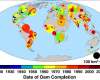
(June 18, 2010) Michael Reilly, writing in Discovery News, says massive dams are altering the global sea level.
PNG tax reform, not overseas aid
(June 18, 2010) In the PNG news, there is an article by Isaac Nicholas that quotes the results of a European Union funded geological survey. The survey data apparently revealed potentially large mineral deposits in the PNG Highlands. The minerals mentioned were copper, gold, silver, zinc, chromium and nickel.
Sudden sinkhole outbreak raises fears in China
(June 17, 2010) China is suffering from a sudden rise in sinkholes, writes Li Hui in The Epoch Times.
With cave-ins, China gets a sinking feeling
(June 17, 2010) Rapid development, not true sinkholes, apparently led to a flurry of cave-ins in China in the weeks after a Guatemala City shocker.
Danjiangkou Reservoir: A tale of two watersheds
(June 16, 2010) In the ultimate photo-op this week, Danjiangkou Mayor Zeng Wenhua, with press in tow, ladled a cup of water out of his city’s reservoir and drank it "without hesitation" to demonstrate its purity. The Danjiangkou Reservoir—on the Hanjiang River, a branch of the middle reaches of the Yangtze River—is slated to provide Beijing with water by 2014, once the central channel of the South-North Water Diversion scheme is completed.
UK to inquire into misuse of India education aid
(June 14, 2010) Britain has launched an inquiry into reports that millions of pounds of aid for education and the ‘Sarva Shiksha Abhiyan’, has disappeared into the depths of corruption without any benefit to the poor children the aid was intended for.
Huang Wanli’s predictions for the Three Gorges come to pass
(June 12, 2010) Huang Wanli, renowned hydraulics engineer and Tsinghua University lecturer, first voiced his opposition to the large-scale damming of rivers by opposing the construction of the Sanmenxia dam in 1957. In the 1980s he became a vocal opponent of the Three Gorges project and contributed to Yangtze! Yangtze!, the important critique of the dam compiled by China’s celebrated investigative journalist, Dai Qing. Now, as the Three Gorges dam is beset by monumental operational problems, Huang Wanli’s prescient analysis helps explain why it was a mistake to build the biggest dam in the world. Read his 1993 interview with Dai Qing.
 Patricia Adams
 Dai Qing
 Fan Xiao
 Lawrence Solomon
 Mu Lan
 Probe International
 Lisa Peryman
 Patricia Adams and Lawrence Solomon
 Other News Sources


