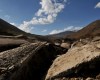
(May 22, 2010) The April 13, 2010 Yushu earthquake damaged three dams on the Batang River, putting one at risk of collapse.

(May 22, 2010) The April 13, 2010 Yushu earthquake damaged three dams on the Batang River, putting one at risk of collapse.
(May 11, 2010) Dams are often presented as a clean source of energy. But, as Heather Gingerich, Probe’s Medical Geologist-in-Residence and current Director of the International Medical Geology Association in Canada, explains, they can trigger earthquakes.
(April 20, 2010) Until the deadly Wenchuan earthquake in China in 2008, no large concrete face rockfill dam (CFRD) had ever been subject to a strong, ground shaking earthquake. But that changed on May 12, 2008 when the Zipingpu hydro dam, one of the largest CFRDs in China and sitting just 17 km from the earthquake epicenter, suffered higher than anticipated seismic forces, causing major damage to its concrete face and deflecting the giant structure 180 mm downstream. A leading scientist now says the earthquake should act as a wake up call for dam builders.
(April 19, 2010) A presentation by Dr. Martin Wieland, Chairman of the International Commission on Large Dams (ICOLD) Committee on Seismic Aspects of Dam Design, on the seismic aspects of dams. Contains stunning photographs of the damage to the Zipingpu dam in the wake of the Wenchuan Earthquake in China’s Sichuan province on May 12, 2008.
(April 16, 2010) Fears of a potential collapse of the Changu dam, once again, highlight the problems of constructing dams in seismically active regions – especially so in China, where the quality of dams has been questioned.
(April 4, 2010) Abstract—With more and more reservoirs have been and are being built all over the world, reservoir-induced earthquake has received a great deal of attention from geoscientists mainly because of its potential to damage constructions and to cause human losses. Based on the previous researches on the environmental conditions of reservoir-induced earthquake, a criteria hierarchy model has been constructed.
(April 1, 2010) More scientists are joining the debate over whether China’s Wenchuan May 2008 earthquake was triggered by the Zipingpu dam.
(March 11, 2010) The large-scale construction that accompanied the building of the Three Gorges dam and its reservoir has increased the number of landslides—both new and reactivated—in the surrounding area. County seats recently built on land near the reservoir are now particularly prone to landslides. Local schools and residential buildings are already suffering cracked foundations and walls.
(February 8, 2010) Following the 12 May 2008 Wenchuan earthquake in China, Chen Houqun, Xu Zeping and Li Ming discuss the question of whether large reservoirs can trigger strong earthquakes.
(January 2010) Following the 12 May 2008 Wenchuan earthquake in China, Chen Houqun, Xu Zeping and Li Ming discuss the question of whether large reservoirs can trigger strong earthquakes.
(November 19, 2009) Peter Bosshard, policy director of International Rivers, provides a nice overview of the controversy surrounding the Zipingpu dam.
(November 18, 2009) Scientists have seen this one before: Fill a reservoir behind a new dam, and, oops, you trigger an earthquake nearby not long after the lake is topped off.
(November 9, 2009) A recent scientific study adds to suggestions that a dam built near an underground geological fault line helped trigger the massive earthquake in Sichuan in May 2008 that killed more than 69,000 people and left almost 18,000 missing.
(November 6, 2009) A recent article by scientists in the U.S. provides further evidence that the Zipingpu dam’s reservoir may have triggered the devastating May 2008 Wenchuan earthquake in China. The Wenchuan earthquake killed nearly 90,000 people and unleashed a chorus of speculation that the Zipingpu reservoir may have contributed to the severity of the earthquake, or helped to trigger it.
(October 28, 2009) A new study published in the journal of Geophysical Research Letters provides more evidence that the deadly Wenchuan earthquake may have been triggered by the Zipingpu dam’s reservoir.



 Patricia Adams
 Dai Qing
 Fan Xiao
 Lawrence Solomon
 Mu Lan
 Probe International
 Lisa Peryman
 Probe Media
 Other News Sources
 Probe International