
(March 10, 2014) Export Development Canada says it needs nearly a year to sort through a mountain of documents regarding its involvement in Libya.
SNC-Lavalin corruption trial: Bangladesh wants the diary
(September 7, 2013) Bangladesh plans to have a anti-corruption official attend the Canadian pre-trial for two former SNC-Lavalin employees charged with corruption in relation to a $1.2-billion Bangladeshi bridge project. Canadian evidence needed to close Bangladesh case.
Deadly earthquake in China may be aftershock of 2008 Wenchuan quake
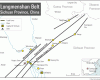
(April 21, 2013) The strong earthquake that struck China’s mountainous Sichuan province Saturday morning may have been an aftershock, says prominent Chinese geologist, Fan Xiao. The accumulation of stress had not yet been fully released, making this region a more dangerous area after the May 2008 Wenchuan earthquake.
SNC-Lavalin executive reveals illegal political donations before corruption inquiry
(March 15, 2013) A vice-president from SNC-Lavalin, Canada’s largest engineering company, admitted yesterday before Quebec’s Charbonneau inquiry into corruption in public-works contracts, that it organized its employees to make more than $1 million in illegal political donations. While there was no direct link between the donations and a quarter-billion dollars in contracts the firm was awarded by the provincial government, Yves Cadotte insisted, the company did not want to take any chances.
Geology expert Yang Yong on the challenges facing China’s most controversial dam projects

(January 5, 2012) Yang Yong on the future of river management in China and the issues currently facing the country’s more controversial dam projects.
The best way to promote human rights in Asia
(December 8, 2011) The Asia Pacific Foundation of Canada held an online conversation on the question: is there a “best way” for Canada to promote human rights in Asia? Patricia Adams of Probe International says that there is: by “getting its own house in order and ensuring that Canada does not aid and abet abuses abroad.”
EDC releases internal documents to Probe International under Access to Information, but reveals little: UPDATE
(February 27, 2009) Heavily censored data keeps tight lip on Canadian investments in Chile.
Memo to Chinese government: no one believes you
(April 15, 2011) Patricia Adams writes: Chinese authorities will invent crimes, if need be, to silence dissidents for exercising their right to freedom of speech. However, renewed efforts to curb criticism and protest reveal an entrenched public distrust towards the government: the people of China, and the world, are done listening.
He who pays the piper calls the mining tune
(October 26, 2010) Industry wants carte blanche use of taxpayers’ funds, writes Patricia Adams in the Financial Post.
Bill C-300: Putting the mining companies in check
(October 18, 2010) Probe International’s Executive Director, Patricia Adams, discusses the upcoming third reading of Bill C-300, which would hold Canadian mining companies accountable for their environmental and human rights abuses.
Ethiopia’s Tekeze Dam fiasco
(November 28, 2009) The recently completed Tekeze hydroelectric dam in Ethiopia is said to be the largest public works project in Africa. It also could turn in to the biggest blunder with disastrous environmental impact, as the investigative report below tries to illustrate. There is so much secrecy surrounding the project that it is not even clear who really paid for it, although the ruling Woyanne junta claims that it has provided all the funding.
Ethiopia’s Tekeze dam limps into operation
(November 23, 2009) The vastly over-budget and long-delayed Tekeze hydro-electric in Ethiopia is finally finished. The project, which was first proposed seven years ago and was scheduled to be competed in 2008, in the end cost $360-million—$136-million over budget.
UK taxpayers foot the bill for PR campaigns by foreign aid groups, says UK economic development think-tank
(October 20, 2009) Stimulus packages aside, the so-called “Great Recession” is forcing government leaders across the world to look for ways to cut back on the cost of public services. No sector, or service, will be spared they say. But Carl Mortishead, writing in The Times, reports there is one government office in the UK that—far from being forced to trim costs—will be given a larger budget: The Department for International Development (DfID), the British government’s foreign aid flagship.
CPPIB venturing into bond market
(April 8, 2009) The Globe and Mail reported on March 26 that Canada’s Pension Plan Investment Board plans to venture into debt markets by selling up to $5-billion in bonds to cut borrowing costs and increase its flexibility to make new investments.
Sen. Navarro calls for nationalization of Chile’s water
(March 5, 2009) Behind Chile’s controversial plans to further dam the rivers of its ecologically delicate Patagonia region, which may soon be partially funded by the Canada Pension Plan (CPP), the Chilean government must first settle a growing debate over who actually controls Patagonia’s rivers. A number of companies were granted legal rights to Patagonia’s rivers during the final years of the infamous Pinochet regime, and the current plan is to build five large dams in the region. Now, the people of Patagonia want control of their rivers back.
 Patricia Adams
 Dai Qing
 Fan Xiao
 Lawrence Solomon
 Mu Lan
 Probe International
 Lisa Peryman
 Probe Media
 Other News Sources


 Probe International