
Canada’s electoral interference watchdog has identified the Chinese government as the source of recent campaigns on China’s largest social media network, aimed at influencing opinions about Liberal Leader Mark Carney.
By Probe International
Canadian officials monitoring the federal election for foreign interference announced on Monday they have identified a Beijing-backed operation on the Chinese social media platform, WeChat, targeting Liberal Leader Mark Carney.
The “information operation” was initiated by Youli-Youmian, WeChat’s most popular news account, which has been linked to the Chinese Communist Party’s central political and legal affairs commission, according to officials from the Security and Intelligence Threats to Elections (SITE) task force.
The operation aimed to influence Chinese-Canadian communities and “mould perceptions” about Carney through articles amplified and circulated by other WeChat accounts “in a coordinated and inauthentic way,” according to the SITE assessment.
Our search of Youli-Youmian on WeChat produced the following examples:
On March 10, 2025, this post (widely shared on We Chat) garnered significant praise:
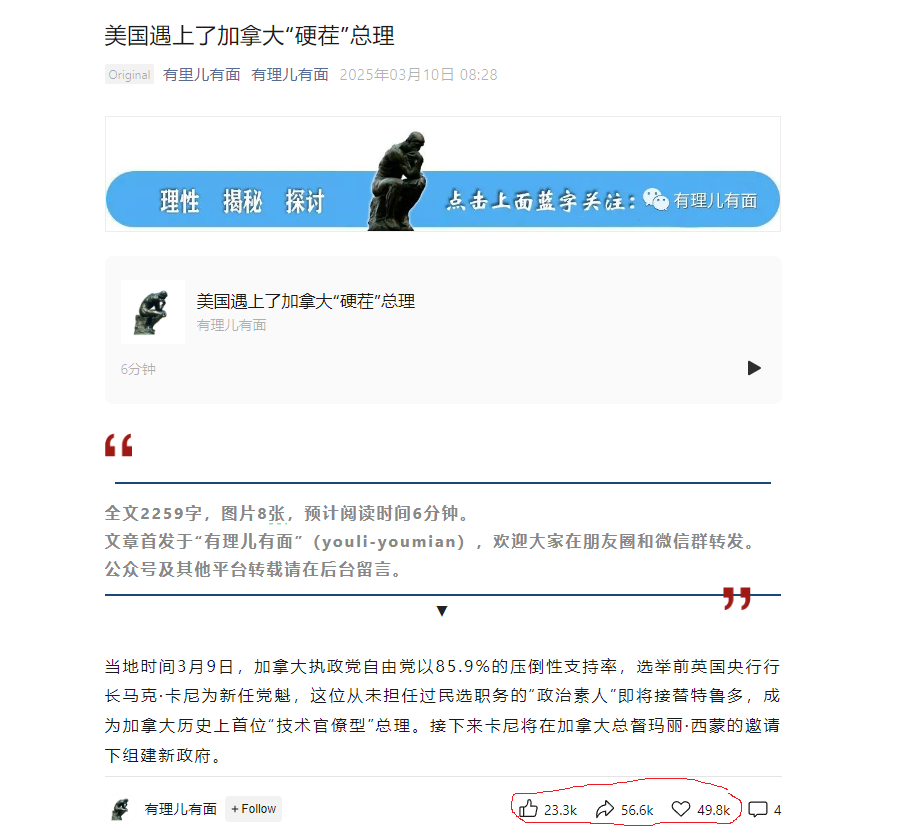
According to the post: “The United States has encountered a tough Canadian Prime Minister who won’t back down.” It quotes Liberal Party ministers endorsing Carney as the best person to “manage” U.S. President Donald Trump and to lead Canada through turbulent times and an energy transition in the coming years.
Another item circulated by the Youli-Youmian account on March 25 reads:
“Canada’s High-Stakes Path to Survival at the Ballot Box: In the coming month, Canadian voters will use their ballots to decide the direction of this political drama—starring Donald Trump and reluctantly co-starring Mark Carney. Will they choose to let Carney continue to ‘stand firm against Trump,’ or will they take a chance on Pierre Poilievre to ‘fight fire with fire’?”

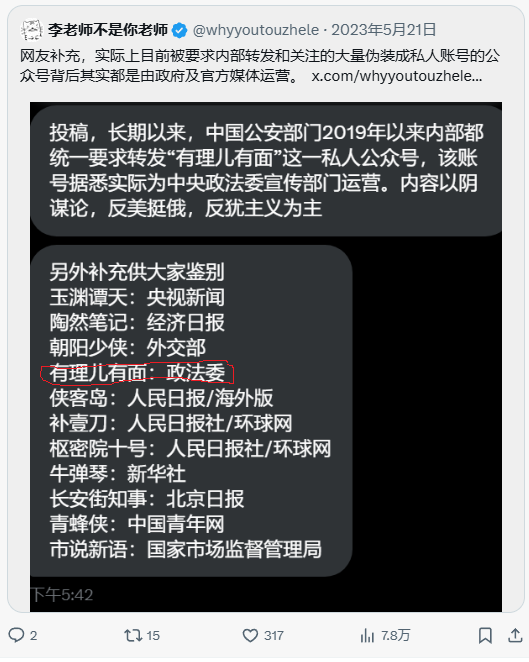
Verifying the Youli-Youmian account links to the People’s Republic of China (PRC) is relatively easy to find and confirm. As early as 2023, the X account Teacher Li is Not Your Teacher—belonging to Li Ying, a Chinese artist turned dissident based in Italy—noted:
“Netizens have pointed out that many [WeChat] accounts currently disguised as personal profiles, which are being pushed internally for sharing and engagement, are in fact operated by the government and state-run media.
Since 2019, China’s public security departments have reportedly been instructed to consistently share content from a so-called private WeChat public account called Youli-Youmian (‘Reasonable and Respectable’). This account is believed to be operated by the Central Political and Legal Affairs Commission. Its content largely focuses on conspiracy theories, anti-American and pro-Russian narratives, and elements of antisemitism.” [Youli-Youmian is outlined in red below].
In its assessment, the SITE Task Force found the Carney-related articles circulated on WeChat via Youli-Youmian garnered 85,000 to 130,000 interactions, and an estimated 1-3 million views. By comparison, SITE found posts by China’s flagship state media, such as the People’s Daily, typically received only around 30,000 interactions. This significantly higher engagement highlights the effectiveness of the amplification tactics used, indicating the operation successfully reached a broad audience on the platform. SITE calculates the false election narratives were elevated to prominence, likely overshadowing organic news within Chinese-language Canadian communities during that period.
The WeChat campaign focused on Mark Carney is part of a pattern of PRC-linked interference targeting Canadian politicians. The SITE report refers to earlier instances where the same Youli-Youmian account was used to spread disinformation about MP Michael Chong (during the federal by-elections in mid-2023) and Chrystia Freeland (in early 2025 before the Liberal leadership vote).
A Globe and Mail article in May 2023, by economist Patricia Adams and law professor Bruce Pardy, credits the Liberal government, under Justin Trudeau, as distinctive for its lack of decisive action to counter foreign interference. Rather than action, the authors describe “an alphabet soup of national security bodies” created to “bar evidence of foreign election interference from public view and Parliament, preventing the government from being held to account.”
As Trudeau’s successor, Carney should have seized on the moment to mark a departure from that landscape of inaction. When asked by reporters about PRC support for him, as evidenced by the WeChat influence campaign, Carney replied: “I have absolutely no idea and I think — well, I’ll leave it at that.”
Denouncing the idea that the Chinese government had effectively endorsed him is a good place to start. The question for voters is: why didn’t he?
Categories: Foreign Interference, Security
 Patricia Adams
 Dai Qing
 Fan Xiao
 Lawrence Solomon
 Mu Lan
 Probe International
 Lisa Peryman
 Probe Media
 Other News Sources


 Probe International